
- November 12, 2026
- admin
- 0
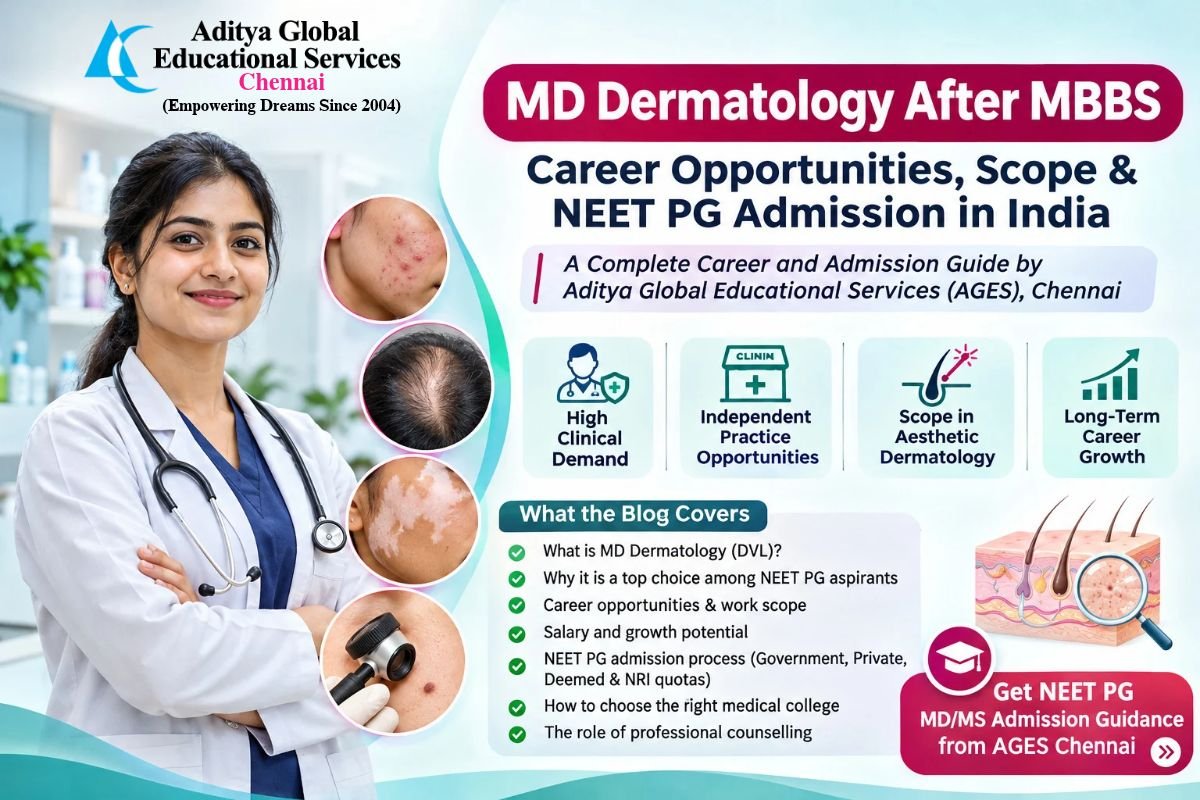
MD Dermatology After MBBS: Career Opportunities, Scope, Salary & NEET PG Admission in India
Are you an MBBS graduate exploring the best postgraduate medical specialisations? Do you aspire to build a career in skin care, hair disorders, clinical dermatology or aesthetic medicine?
MD Dermatology, Venereology and Leprosy (DVL) is an attractive postgraduate medical speciality for doctors interested in clinical diagnosis, patient care and specialised dermatological treatments.
From managing common skin conditions to treating complex dermatological diseases and performing specialised procedures, dermatology offers diverse professional opportunities. It also provides pathways into independent clinical practice, hospital consultancy, medical education and advanced procedural specialisation.
However, securing an MD Dermatology seat through NEET PG can be competitive. Understanding the admission process, college options, eligibility requirements and counselling pathways is essential before making your decision.
In this comprehensive guide, Aditya Global Educational Services (AGES), Chennai, explains everything MBBS graduates should know about MD Dermatology after MBBS, including course details, career scope, earning potential, admission options and NEET PG counselling.
What Is MD Dermatology?
MD Dermatology, Venereology and Leprosy (DVL) is a postgraduate medical programme that focuses on diagnosing and treating diseases affecting the skin, hair, nails and related structures.
The programme generally has a duration of three years after MBBS, subject to applicable postgraduate medical education regulations.
Dermatologists manage a wide range of conditions, including:
Acne, pimples and acne scars
Skin pigmentation and melasma
Eczema and psoriasis
Vitiligo
Hair loss and scalp disorders
Fungal and bacterial skin infections
Viral skin infections
Autoimmune skin diseases
Sexually transmitted infections
Leprosy and associated complications
The speciality combines medical knowledge, clinical examination, diagnostic skills and procedural expertise.
Why Is MD Dermatology One of the Preferred NEET PG Specialisations?
MD Dermatology attracts many postgraduate medical aspirants because of its combination of clinical practice, specialised treatments and diverse career possibilities.
Here are some important reasons doctors consider this branch.
1. Growing Need for Dermatological Care
Skin and hair conditions affect people across different age groups. Acne, pigmentation, allergies, infections, hair loss and chronic skin diseases are among the conditions that require dermatological evaluation.
This creates opportunities for dermatologists in hospitals, specialised clinics and independent practice.
2. Opportunities for Independent Clinical Practice
After completing the required postgraduate training and meeting applicable professional requirements, dermatologists can explore independent clinical practice.
A dermatologist may establish a clinic offering consultations and appropriate dermatological treatments.
3. Scope in Aesthetic Dermatology
Aesthetic dermatology is another area of professional development.
Depending on additional training, qualifications and procedural competence, dermatologists may explore:
Laser-based skin treatments
Acne scar management
Pigmentation treatments
Hair restoration services
Skin rejuvenation procedures
Selected cosmetic dermatological procedures
Appropriate training, patient selection and procedural safety are essential in this field.
4. Opportunities in Hospitals and Specialised Clinics
Dermatologists can work in multispeciality hospitals, dermatology departments, skin and hair treatment centres and specialised medical clinics.
5. Multiple Long-Term Career Pathways
The branch offers opportunities in clinical practice, teaching, research, hospital consultancy and advanced procedural training.
For doctors who enjoy patient interaction and specialised clinical care, MD Dermatology can be a rewarding professional pathway.
MD Dermatology Course Duration and Training
MD Dermatology is generally a three-year postgraduate programme following MBBS.
During training, residents develop knowledge and practical experience in different areas of dermatology.
Important areas of training include:
Clinical Dermatology: Diagnosis and management of common and complex skin diseases.
Trichology: Evaluation of hair loss, scalp disorders and related conditions.
Dermatosurgery: Exposure to selected dermatological surgical procedures, including skin biopsies.
Dermoscopy: Examination of skin lesions using specialised magnification techniques.
Cryotherapy: Use of controlled freezing techniques for appropriate dermatological conditions.
Venereology: Diagnosis and management of sexually transmitted infections.
Leprosy: Identification, treatment and management of leprosy and its complications.
The quality of practical exposure, faculty supervision and procedural training can vary between institutions. Candidates should evaluate the department carefully before selecting a college.
Career Opportunities After MD Dermatology
One of the important considerations when choosing a postgraduate speciality is the range of career opportunities available after completing the course.
MD Dermatology offers several possible professional pathways.
1. Consultant Dermatologist
Dermatologists can work in hospitals and specialised clinics, diagnosing and treating patients with different skin, hair and nail conditions.
2. Private Dermatology Clinic
Qualified specialists may establish independent dermatology practices, subject to applicable regulations and professional requirements.
3. Aesthetic Dermatology Specialist
With appropriate additional training and practical competence, dermatologists can develop expertise in selected aesthetic and procedural treatments.
4. Hair and Scalp Treatment Services
Doctors interested in hair disorders can focus on diagnosing and managing hair loss, scalp conditions and related dermatological problems.
5. Medical College Faculty
MD Dermatology graduates may pursue teaching and academic careers, subject to applicable eligibility criteria.
6. Clinical Research
Dermatology also offers opportunities in clinical research, medical publications and specialised areas of dermatological science.
What Is the Salary After MD Dermatology in India?
Salary is an important consideration for medical graduates planning their postgraduate education.
However, there is no single fixed salary for MD Dermatology graduates.
Earnings can vary depending on:
Years of clinical experience
City and geographical location
Hospital or clinic
Nature of employment
Patient volume
Additional procedural training
Independent practice versus salaried employment
Doctors working in hospitals may receive employment-based compensation, while independent practitioners may generate income through consultations and treatments.
Dermatologists who develop additional procedural expertise may explore further professional opportunities.
Important: Candidates should not select a postgraduate speciality based on salary expectations alone. Clinical interest, training quality, professional development and long-term career satisfaction are equally important.
MD Dermatology Admission Through NEET PG
Admission to MD Dermatology programmes in India generally takes place through NEET PG counselling, subject to applicable eligibility criteria and regulations.
Because MD Dermatology is a competitive speciality, candidates should understand their rank, category, available seats and counselling options before preparing their preferences.
Candidates may explore the following admission pathways.
1. Government Medical Colleges
Government medical colleges generally offer comparatively affordable postgraduate medical education.
However, MD Dermatology seats can be highly competitive, and admission depends on merit, applicable reservation policies and seat availability.
2. Private Medical Colleges
Private medical colleges offer postgraduate medical seats through the relevant counselling authorities and applicable seat categories.
Candidates should compare tuition fees, eligibility, clinical exposure and the institution’s dermatology department before selecting a college.
3. Deemed Universities
Participating deemed universities offer postgraduate medical admission through the applicable MCC counselling process.
Candidates should verify the current seat matrix, fee structure, eligibility conditions and admission requirements.
4. Management Quota
Eligible candidates may explore management-category seats in participating private medical colleges, wherever such seats are permitted.
Admission remains subject to applicable merit requirements, counselling regulations and seat availability.
5. NRI Quota
Some participating institutions offer postgraduate seats under NRI categories, subject to applicable eligibility and documentation requirements.
Candidates and parents should verify the institution-specific conditions before proceeding.
Note: Seat availability, fee structures, eligibility and closing ranks vary by college, category and counselling round. Historical allotment information is useful for planning but cannot guarantee admission.
How to Choose the Right College for MD Dermatology?
Choosing the right postgraduate medical college is as important as selecting the speciality.
A college should provide an appropriate learning environment, good clinical exposure and opportunities to develop practical skills.
Before shortlisting colleges, evaluate the following factors.
1. Previous-Year NEET PG Closing Ranks
Review historical closing ranks for MD Dermatology across relevant colleges and counselling categories.
This can help candidates understand previous admission trends and identify realistic options.
2. Dermatology Department and Faculty
Evaluate the experience of faculty members, department facilities and the quality of academic training.
3. Clinical Patient Exposure
A good dermatology department should provide meaningful exposure to different skin conditions, diagnostic procedures and treatment approaches.
4. Practical and Procedural Training
Look into opportunities for supervised training in dermoscopy, skin biopsies, cryotherapy and other relevant procedures.
5. Total Course Fees
Compare tuition fees, admission deposits, hostel charges and other applicable expenses.
Parents should understand the complete financial commitment before finalising a college.
6. Recognition and Approved Intake
Verify the institution’s current recognition and approved postgraduate intake through applicable official sources.
7. Counselling Eligibility
Check the rules applicable to All India, state, deemed university, management and NRI counselling routes.
Why Is Professional NEET PG Counselling Important for MD Dermatology?
MD Dermatology is a competitive postgraduate speciality. Candidates may overlook suitable admission possibilities because they are unfamiliar with counselling procedures, historical allotment trends, eligibility conditions or available seat categories.
A structured counselling strategy can help candidates understand their realistic options.
For example, a proper admission-planning exercise should consider:
NEET PG All India Rank
Category and applicable eligibility
State domicile requirements
Preferred medical speciality
Previous-year closing ranks
Government and private college options
Management-category availability
Deemed university options
NRI-category eligibility
College fee structure
Round-wise counselling rules
Candidates should approach choice filling carefully and understand the consequences of accepting, upgrading or resigning from a seat under the applicable rules.
How Aditya Global Educational Services (AGES), Chennai Helps MD Dermatology Aspirants
Selecting a medical college for MD Dermatology can be challenging, particularly when candidates are comparing different counselling routes, college fees and admission possibilities.
Aditya Global Educational Services (AGES), Chennai, provides personalised NEET PG admission counselling guidance for candidates and parents exploring MD/MS postgraduate medical admissions across India.
Our support includes:
NEET PG Rank Analysis
We help candidates understand their All India Rank, category, domicile and admission preferences to evaluate relevant college options.
College-Wise Admission Possibilities
We assist in shortlisting colleges based on applicable eligibility, previous-year allotment trends and available counselling pathways.
Government, Management and NRI Counselling Guidance
We help candidates understand relevant admission categories and their applicable requirements.
College Fee Comparison
We assist families in comparing tuition fees and overall financial commitments across shortlisted institutions.
Choice Filling and Counselling Strategy
We provide guidance on preference planning and applicable round-wise counselling procedures.
Admission Documentation and Reporting
We assist candidates in understanding document verification and reporting formalities.
Our objective is to help students and parents make informed admission decisions based on rank, preferred speciality, college options, eligibility and budget.
Frequently Asked Questions About MD Dermatology After MBBS
1. Is MD Dermatology a good branch after MBBS?
MD Dermatology can be a good choice for doctors interested in clinical practice, skin and hair disorders, specialised treatments and patient care. Its suitability depends on individual interests and career goals.
2. What is the duration of MD Dermatology?
MD Dermatology is generally a three-year postgraduate medical programme after MBBS, subject to applicable regulations.
3. How can I get MD Dermatology admission in India?
Eligible candidates generally need to qualify NEET PG and participate in the applicable counselling process. Admission depends on merit, eligibility, category, seat availability and counselling rules.
4. Can I get MD Dermatology through management quota?
Eligible candidates may explore management-category seats in participating private medical colleges, subject to applicable merit requirements, counselling regulations and seat availability.
5. Is MD Dermatology available under NRI quota?
Some participating institutions offer NRI-category postgraduate medical seats. Candidates should verify the eligibility and documentation requirements for the relevant admission year.
6. Can I get MD Dermatology with a lower NEET PG rank?
Admission possibilities depend on several factors, including rank, category, eligibility, college preferences, counselling route, budget and available vacancies.
Previous-year closing ranks can help with planning but cannot guarantee admission.
7. What are the career options after MD Dermatology?
Graduates may explore consultant dermatology practice, private clinics, hospital consultancy, aesthetic dermatology, hair and scalp treatment services, medical teaching and clinical research.
8. Does MD Dermatology have scope in aesthetic medicine?
Yes. Dermatologists with appropriate additional training and procedural competence may pursue selected aesthetic dermatology services, including laser treatments, acne scar management and pigmentation care.
9. How do I select the right college for MD Dermatology?
Compare previous-year closing ranks, department quality, faculty, patient exposure, procedural training, fees, recognition and counselling eligibility.
10. How can AGES Chennai help with MD Dermatology admission?
AGES provides guidance with NEET PG rank analysis, college shortlisting, fee comparison, counselling strategy, choice filling and admission documentation.
Conclusion: Plan Your MD Dermatology Admission with the Right Guidance
MD Dermatology offers an exciting combination of clinical medicine, specialised patient care, procedural treatments and long-term career development.
For MBBS graduates who are interested in dermatological diagnosis and treatment, it can be an attractive postgraduate speciality.
However, choosing the right medical college requires careful consideration of NEET PG rank, eligibility, clinical training, fees and counselling options.
Rather than relying only on previous-year cut-offs or general admission assumptions, candidates should make decisions based on verified information and their individual circumstances.
Planning to pursue MD Dermatology after MBBS?
Connect with Aditya Global Educational Services (AGES), Chennai, for guidance on NEET PG rank analysis, college shortlisting, management and NRI admission pathways, and postgraduate medical counselling.
ADITYA GLOBAL EDUCATIONAL SERVICES (AGES)
NEET UG & NEET PG Admission Counselling
Chennai, Tamil Nadu
Call: +91 98843 50887
Website: https://www.admissionhelps.com/
Your NEET PG Rank. Your Preferred Branch. Our Counselling Guidance.