
- November 11, 2026
- admin
- 0
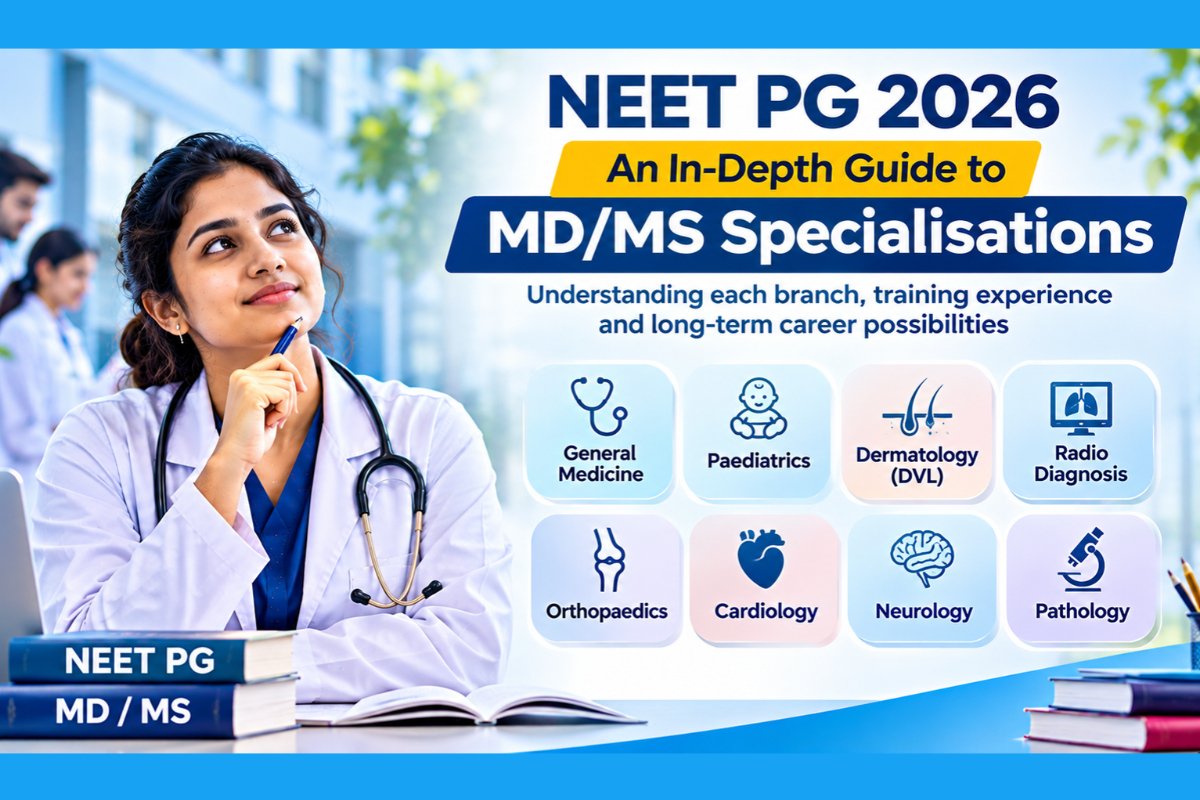
NEET PG 2026: Complete Guide to MD/MS Specialisations, Career Opportunities & How to Choose the Right Branch
Completing MBBS is a significant milestone in every doctor’s journey. However, choosing the right postgraduate medical specialisation is one of the most important decisions that follows. With several MD and MS branches available, NEET PG aspirants often find themselves wondering: Which is the best branch after MBBS? Which specialisation offers better career opportunities? Should I choose a clinical or surgical branch? What factors should I consider before filling my counselling choices?
The answer is not the same for everyone.
NEET PG 2026 is not just about securing a postgraduate medical seat; it is about choosing a specialisation that aligns with your clinical interests, professional strengths, career aspirations and long-term goals.
Whether you are interested in patient care, surgery, diagnostic medicine, medical research or specialised clinical practice, understanding each postgraduate branch can help you make a more informed decision.
In this comprehensive guide, Aditya Global Educational Services (AGES), Chennai, explores the major MD/MS specialisations after MBBS, their training requirements, everyday clinical responsibilities, career opportunities and important considerations for NEET PG 2026 counselling.
Understanding MD and MS Specialisations After MBBS
After completing MBBS, eligible medical graduates can pursue postgraduate medical education through MD (Doctor of Medicine) or MS (Master of Surgery) programmes.
Broadly, these postgraduate pathways cover different areas of medical practice.
MD (Doctor of Medicine): Generally focuses on medical specialities involving diagnosis, non-surgical treatment, clinical management and specialised medical care.
MS (Master of Surgery): Generally focuses on surgical specialities involving operative procedures, surgical decision-making and the management of conditions requiring surgical intervention.
The nature of training, clinical responsibilities and future career pathways differs from one speciality to another.
Choosing a branch should involve more than considering its popularity or perceived earning potential. Your interest in the subject, preferred working environment, training quality and future professional goals should all play an important role.
Top MD/MS Specialisations After MBBS: Detailed Branch-Wise Guide
Let’s explore some of the major postgraduate medical specialisations and understand what each branch offers.
1. MD Dermatology, Venereology & Leprosy (DVL)
Dermatology is a medical speciality focusing on diseases and conditions affecting the skin, hair, nails and related areas.
What will you study?
During MD Dermatology training, residents develop expertise in identifying and managing:
Skin infections and inflammatory conditions
Acne and pigmentation disorders
Hair and nail disorders
Autoimmune skin diseases
Sexually transmitted infections
Leprosy and other dermatological conditions
Skin cancers
Clinical training and practical exposure
Training involves outpatient consultations, dermoscopy, skin biopsies, minor procedures and treatment planning. Exposure to lasers and aesthetic procedures depends on the institution and available training opportunities.
Career opportunities after MD Dermatology
Consultant dermatologist
Hospital-based dermatology practice
Independent dermatology clinics
Hair and nail treatment services
Procedural and aesthetic dermatology
Medical teaching and academics
Who should choose Dermatology?
This branch may suit doctors who enjoy visual diagnosis, detailed clinical examination, outpatient consultations and long-term patient relationships.
2. MD General Medicine
General Medicine is one of the broadest medical specialities. It involves diagnosing, treating and managing adult patients with a wide range of medical conditions.
What will you study?
The speciality covers multiple organ systems and conditions, including:
Diabetes and metabolic disorders
Cardiovascular diseases
Infectious diseases
Respiratory conditions
Kidney-related disorders
Autoimmune diseases
Complex medical conditions
Clinical training and practical exposure
Residents gain experience in patient history-taking, physical examinations, diagnostic reasoning, inpatient management, emergency care and multidisciplinary coordination.
Ward rounds, emergency duties and the management of critically ill patients are important components of training.
Career opportunities after MD General Medicine
Consultant physician
Hospital-based physician
Independent medical practice
Medical college teaching
Further specialisation through eligible DM/DrNB pathways, including cardiology, neurology and gastroenterology.
Who should choose General Medicine?
Doctors who enjoy clinical reasoning, diagnosing complex conditions and managing patients over time may find General Medicine rewarding.
3. MD Paediatrics
Paediatrics focuses on the health and medical care of newborns, infants, children and adolescents.
What will you study?
Newborn and neonatal care
Childhood infections
Growth and developmental assessment
Childhood nutritional disorders
Vaccination and preventive healthcare
Paediatric emergencies
Chronic childhood illnesses
Clinical training and practical exposure
Training includes outpatient consultations, neonatal care, developmental assessments, emergency management and communication with parents.
Depending on the institution, residents may receive exposure to Neonatal Intensive Care Units (NICU) and Paediatric Intensive Care Units (PICU).
Career opportunities after MD Paediatrics
Consultant paediatrician
Neonatal care services
Children’s hospitals
General paediatric clinics
Medical teaching
Further paediatric subspecialty training
Who should choose Paediatrics?
This speciality is suitable for doctors who enjoy working with children, communicating with families and managing medical conditions across different stages of childhood.
4. MD Radio Diagnosis (Radiology)
Radiodiagnosis plays a crucial role in modern healthcare by helping doctors identify diseases and assess medical conditions through imaging technologies.
What will you study?
X-ray imaging
Ultrasound
Computed Tomography (CT)
Magnetic Resonance Imaging (MRI)
Imaging-based diagnosis
Anatomical and pathological interpretation
Clinical training and practical exposure
Residents develop strong anatomical knowledge, image interpretation skills, diagnostic accuracy and reporting expertise.
Some institutions also provide exposure to image-guided procedures. Advanced interventional radiology practice generally requires further specialised training.
Career opportunities after MD Radio Diagnosis
Consultant radiologist
Hospital radiology departments
Diagnostic imaging centres
Specialised imaging services
Medical teaching
Further training in advanced imaging and interventional radiology
Who should choose Radiology?
Radiology may appeal to doctors interested in technology, anatomy, analytical thinking and diagnostic medicine.
5. MS Orthopaedics
Orthopaedics deals with conditions affecting bones, joints, muscles, ligaments and the overall musculoskeletal system.
What will you study?
Bone fractures
Joint disorders
Sports-related injuries
Ligament injuries
Musculoskeletal deformities
Trauma management
Joint reconstruction
Clinical training and practical exposure
Training involves fracture management, casting, trauma assessment, operative procedures, fracture fixation, rehabilitation planning and outpatient follow-up.
Emergency trauma duties and operating-theatre exposure are significant aspects of this speciality.
Career opportunities after MS Orthopaedics
Orthopaedic surgeon
Trauma surgeon
Joint reconstruction specialist
Sports injury management
Hospital-based orthopaedic practice
Further specialised training in areas such as spine surgery
Who should choose Orthopaedics?
Doctors who enjoy anatomy, hands-on procedures, surgical practice and solving musculoskeletal problems may find this branch suitable.
6. MS Obstetrics & Gynaecology (OBG)
Obstetrics and Gynaecology is a speciality dedicated to pregnancy, childbirth, maternal health and conditions affecting the female reproductive system.
What will you study?
Antenatal care
Pregnancy-related complications
Labour and delivery
Maternal health
Gynaecological disorders
Reproductive health
Gynaecological surgery
Clinical training and practical exposure
Residents gain experience in antenatal clinics, labour wards, emergency obstetrics, caesarean deliveries, gynaecological procedures and patient counselling.
The ability to manage emergencies and make timely clinical decisions is essential.
Career opportunities after MS OBG
Consultant gynaecologist
Obstetrician
Maternity hospital practice
Women’s healthcare clinics
Gynaecological surgery
Medical teaching
Further training in reproductive medicine and maternal-fetal care
Who should choose OBG?
This speciality may suit doctors who enjoy a combination of medical care, surgery, patient counselling and long-term relationships with patients.
7. MS General Surgery
General Surgery focuses on the diagnosis, surgical treatment and postoperative management of various medical conditions.
What will you study?
Surgical diseases
Gastrointestinal conditions
Abdominal emergencies
Wound management
Surgical anatomy
Perioperative patient care
Trauma and emergency surgery
Clinical training and practical exposure
Residents develop operative skills, learn surgical decision-making, participate in emergency assessments and gain experience in preoperative and postoperative care.
Practical surgical competence develops through supervised case exposure and continued training.
Career opportunities after MS General Surgery
General surgeon
Hospital-based surgical practice
Minimally invasive surgery
Trauma care
Surgical teaching
Further eligible MCh/DrNB super-specialisation
Who should choose General Surgery?
Doctors who enjoy operating, developing technical skills and managing surgical emergencies may find General Surgery a suitable choice.
8. MD Anaesthesiology
Anaesthesiology is an essential speciality that ensures patient safety during surgical procedures and other medical interventions.
What will you study?
General anaesthesia
Regional anaesthesia
Airway management
Patient monitoring
Pain management
Resuscitation
Ventilatory support
Emergency management
Clinical training and practical exposure
Training involves pre-anaesthetic evaluation, pharmacology, physiology, anaesthesia techniques, monitoring and managing complications.
Exposure to intensive care medicine varies between training institutions.
Career opportunities after MD Anaesthesiology
Consultant anaesthesiologist
Operating-theatre anaesthesia services
Perioperative medicine
Pain management clinics
Critical care after appropriate training
Specialised anaesthesia services
Who should choose Anaesthesiology?
This branch may suit doctors interested in physiology, pharmacology, procedures, teamwork and making important decisions in critical situations.
9. MD Psychiatry
Psychiatry focuses on diagnosing, treating and managing mental, emotional and behavioural health conditions.
What will you study?
Mood disorders
Anxiety disorders
Psychotic disorders
Substance use disorders
Behavioural conditions
Psychiatric emergencies
Mental health assessment
Clinical training and practical exposure
Residents develop skills in psychiatric interviews, risk assessment, psychopharmacology, psychotherapy exposure and collaborative mental healthcare.
Career opportunities after MD Psychiatry
Consultant psychiatrist
Private psychiatric practice
Hospital psychiatry departments
Addiction treatment services
Community mental healthcare
Medical teaching
Further subspecialty training
Who should choose Psychiatry?
Doctors who value communication, empathy, detailed patient assessment and long-term therapeutic relationships may find Psychiatry fulfilling.
10. MS Ophthalmology
Ophthalmology is the medical and surgical speciality concerned with eye health and vision-related disorders.
What will you study?
Cataracts
Glaucoma
Retinal disorders
Corneal conditions
Eye infections
Refractive disorders
Eye emergencies
Clinical training and practical exposure
Training includes slit-lamp examination, fundoscopy, refraction-related assessment, clinical diagnosis and graded surgical exposure.
Career opportunities after MS Ophthalmology
Consultant ophthalmologist
Eye hospital practice
Cataract surgery
Comprehensive ophthalmic care
Glaucoma and retinal services after focused training
Medical teaching
Independent eye clinics
Who should choose Ophthalmology?
Doctors who enjoy precision, fine motor skills, detailed examination and a combination of outpatient and surgical practice may find this branch suitable.
11. MS ENT (Otorhinolaryngology)
ENT focuses on medical and surgical conditions affecting the ear, nose, throat and related head-and-neck structures.
What will you study?
Ear and hearing disorders
Nasal and sinus conditions
Throat disorders
Voice-related conditions
Balance disorders
Selected head-and-neck conditions
Clinical training and practical exposure
Training combines outpatient examinations, endoscopy, audiology exposure, airway management and surgical procedures.
Career opportunities after MS ENT
ENT consultant
Ear and hearing services
Sinus and nasal surgery
Head-and-neck services with further training
Hospital practice
Medical teaching
Who should choose ENT?
ENT may suit doctors who enjoy anatomical detail and a combination of clinical consultations, diagnostic procedures and surgery.
12. MD Respiratory Medicine
Respiratory Medicine deals with diseases affecting the lungs and respiratory system.
What will you study?
Asthma
Chronic Obstructive Pulmonary Disease (COPD)
Tuberculosis
Pneumonia
Interstitial lung diseases
Respiratory infections
Respiratory failure
Clinical training and practical exposure
Training includes pulmonary examination, lung-function testing, respiratory imaging, bronchoscopy exposure and the management of acute respiratory conditions.
Career opportunities after MD Respiratory Medicine
Consultant pulmonologist
Hospital respiratory services
Respiratory clinics
Bronchoscopy services
Sleep-related care with appropriate training
Further advanced training
Who should choose Respiratory Medicine?
Doctors interested in managing chronic respiratory diseases as well as acute and emergency medical conditions may consider this branch.
13. MD Emergency Medicine
Emergency Medicine focuses on the immediate assessment, stabilisation and management of patients presenting with acute illnesses and injuries.
What will you study?
Emergency patient assessment
Trauma management
Cardiac emergencies
Resuscitation
Toxicology
Acute medical conditions
Emergency procedures
Clinical training and practical exposure
Residents gain experience in triage, resuscitation, bedside procedures, trauma assessment and coordination with other medical specialities.
Career opportunities after MD Emergency Medicine
Emergency medicine consultant
Hospital emergency departments
Trauma and acute-care services
Emergency medical education
Hospital leadership
Emergency-care quality improvement
Who should choose Emergency Medicine?
This branch is suitable for doctors who enjoy fast-paced environments, immediate decision-making and managing unpredictable clinical situations.
14. MD Radiation Oncology
Radiation Oncology is a specialised field of cancer treatment that uses radiation therapy as part of comprehensive cancer care.
What will you study?
Cancer staging
Radiotherapy planning
Radiation treatment techniques
Cancer patient assessment
Treatment-related side effects
Follow-up and supportive care
Clinical training and practical exposure
Training includes treatment planning, patient counselling, toxicity management and coordination with multidisciplinary cancer teams.
Career opportunities after MD Radiation Oncology
Consultant radiation oncologist
Cancer centres
Hospital radiotherapy departments
Academic oncology
Multidisciplinary cancer services
Who should choose Radiation Oncology?
Doctors interested in cancer treatment, medical technology, detailed treatment planning and long-term patient relationships may find this speciality rewarding.
15. MD Pathology – A Para-Clinical Speciality
Pathology is an essential diagnostic speciality that helps identify diseases through laboratory investigations and the examination of tissues, cells and blood samples.
Although it is a para-clinical branch rather than a clinical MD/MS speciality, it deserves consideration because of its important role in modern medical diagnosis.
What will you study?
Histopathology
Cytopathology
Haematology
Laboratory investigations
Clinicopathological correlation
Laboratory quality management
Molecular diagnostic techniques, depending on institutional exposure
Clinical training and practical exposure
Training focuses on microscopy, laboratory interpretation, diagnostic accuracy and understanding disease processes.
Career opportunities after MD Pathology
Consultant pathologist
Diagnostic laboratory practice
Hospital pathology departments
Academic pathology
Laboratory leadership
Advanced diagnostic subspecialisation
Who should choose Pathology?
Pathology may suit doctors who enjoy scientific analysis, microscopy, laboratory-based diagnosis and understanding diseases rather than routine direct patient management.
How to Choose the Right MD/MS Branch After MBBS?
One of the biggest mistakes NEET PG aspirants make is selecting a branch solely because it is popular among other candidates.
A speciality that suits one doctor may not necessarily be the right choice for another.
Before finalising your postgraduate preferences, consider these important factors.
1. Identify Your Interest: Medical or Surgical Practice
Ask yourself whether you enjoy diagnosing and managing medical conditions or performing surgical procedures.
If you prefer clinical diagnosis and medical management, you may explore branches such as General Medicine, Paediatrics, Dermatology and Respiratory Medicine.
If you enjoy operative procedures and surgical practice, consider branches such as General Surgery, Orthopaedics, OBG, Ophthalmology and ENT.
2. Consider Your Preferred Working Environment
Different specialities involve different professional environments.
Some branches involve extensive outpatient consultations, while others require significant inpatient care, emergency duties, operating-theatre work or diagnostic reporting.
Think about the type of professional routine you would enjoy over the long term.
3. Evaluate Emergency Duties and Workload
Emergency responsibilities and night duties differ across specialities and institutions.
For example, General Medicine, OBG, General Surgery and Emergency Medicine can involve demanding emergency responsibilities.
Understand the practical demands of a branch before making your decision.
4. Explore Long-Term Career Opportunities
Consider where you would like to work after completing your postgraduate education.
Possible career directions include:
Independent clinical practice
Corporate and multispeciality hospitals
Diagnostic centres
Specialised medical clinics
Academic medicine
Research and teaching
Further super-specialty training
Your chosen branch should support your long-term professional goals.
5. Evaluate the Medical College Carefully
The quality of postgraduate training is extremely important.
While comparing colleges, examine:
Clinical case exposure
Patient load
Faculty experience and supervision
Infrastructure and facilities
Operating-theatre exposure
Emergency and intensive care facilities
Practical training opportunities
Recognition and applicable regulatory requirements
A branch should not be selected without understanding the training environment offered by the institution.
NEET PG 2026 Counselling: Important Factors Before Filling Your Choices
Once you have identified your preferred specialisations, the next important step is postgraduate medical counselling.
NEET PG counselling involves several considerations beyond your examination performance.
Before filling your choices, carefully review the following:
1. Official Seat Matrix: Check the latest available seat matrix and confirm the seats offered by participating institutions.
2. Counselling Quota: Understand the applicable All India, state, deemed university, management or NRI counselling routes.
3. Eligibility Requirements: Verify the eligibility conditions applicable to your category and counselling authority.
4. Course and College Recognition: Check the current recognition and approval status of the institution and programme through applicable official sources.
5. Fee Structure: Compare tuition fees, admission deposits, other charges and the overall financial commitment.
6. Bond and Service Obligations: Understand any applicable service bonds, compulsory service conditions or financial penalties.
7. Choice Filling Strategy: Arrange your preferences after considering your desired speciality, college, budget and eligibility.
8. Reporting and Upgradation Rules: Understand reporting deadlines, document requirements, upgradation provisions and resignation policies.
Important: Counselling rules, seat availability, fees and admission conditions may change between rounds and authorities. Always refer to the latest official counselling notifications and college documents. Do not rely solely on previous-year information.
Why Professional Guidance Matters in NEET PG 2026 Counselling
Selecting a postgraduate medical seat is a major academic and financial decision.
Candidates often face questions such as:
Which specialisation should I prioritise?
Should I choose my preferred branch or a preferred college?
How should I shortlist colleges within my budget?
Which counselling routes should I consider?
What documents are required during admission?
What should I understand before accepting a seat?
How do I plan my choices across different counselling rounds?
A well-planned counselling strategy can help candidates understand their available options and make informed decisions.
However, no counselling service can guarantee a particular seat or admission outcome. Final admission depends on eligibility, merit, official regulations and seat availability.
NEET PG 2026 Admission Guidance by Aditya Global Educational Services (AGES), Chennai
Choosing the right postgraduate specialisation and navigating the counselling process can be challenging for both candidates and parents.
Aditya Global Educational Services (AGES), Chennai, provides guidance and support to NEET PG aspirants and families throughout the postgraduate medical admission process.
Our assistance includes:
MD/MS branch and college shortlisting
Budget-based college planning
Counselling choice guidance
All India and applicable state counselling routes
Deemed university counselling guidance
Management and NRI counselling guidance
Admission documentation assistance
Admission-process guidance
Our objective is to help candidates understand their available options and approach the admission process with better clarity.
Whether you are exploring clinical specialities, surgical branches or other postgraduate medical pathways, making an informed decision is the first step towards building a successful medical career.
Planning your MD/MS admission after NEET PG 2026?
Connect with AGES Chennai for personalised guidance on branch selection, college shortlisting and postgraduate medical counselling.
Aditya Global Educational Services (AGES)
Chennai, Tamil Nadu
Website: https://www.admissionhelps.com/
Phone: +91 98843 50887
Frequently Asked Questions About NEET PG 2026 MD/MS Specialisations
1. Which are the major MD/MS specialisations available after MBBS?
Major postgraduate specialisations include MD General Medicine, MD Dermatology, MD Paediatrics, MD Radio Diagnosis, MD Anaesthesiology, MD Psychiatry, MS General Surgery, MS Orthopaedics, MS OBG, MS Ophthalmology and MS ENT, among others.
The actual available branches and seats should be checked in the applicable official seat matrix.
2. Which MD branch is best after MBBS?
There is no single best MD branch for every doctor. The right choice depends on clinical interests, preferred working environment, aptitude, career goals, training quality and financial considerations.
3. Which MS branches can doctors consider after MBBS?
Some major MS specialisations include General Surgery, Orthopaedics, Obstetrics & Gynaecology, Ophthalmology and ENT.
Candidates should verify the available courses and eligibility in the current counselling information.
4. What is the difference between MD and MS?
MD generally focuses on medical diagnosis, treatment and non-surgical clinical management, whereas MS focuses on surgical specialities and operative management.
The actual nature of training varies according to the chosen branch.
5. Is Radiology a good postgraduate speciality?
Radiodiagnosis is an important speciality involving X-ray, ultrasound, CT and MRI interpretation. It may suit doctors interested in anatomy, technology and diagnostic medicine. Career opportunities depend on training, skills and practice settings.
6. What should I consider before selecting a postgraduate medical college?
Consider patient load, clinical exposure, faculty supervision, infrastructure, practical training, course recognition, fees, bond conditions and institutional training quality.
7. Can I consider different counselling routes for NEET PG admission?
Candidates should understand the applicable All India, state, deemed university, management and NRI counselling routes, subject to the current official eligibility rules and regulations.
8. How can AGES Chennai help with NEET PG 2026 admissions?
Aditya Global Educational Services provides branch and college shortlisting, budget-based planning, counselling choice guidance, documentation assistance and admission-process guidance across applicable counselling routes.
9. Is MD Pathology a clinical speciality?
MD Pathology is classified as a para-clinical speciality. It focuses on disease diagnosis through laboratory investigations, tissue examination, cellular analysis and related diagnostic methods.
10. Should I select a branch based only on its popularity?
No. Popularity should not be the deciding factor. Candidates should assess their interests, training opportunities, professional goals, workload preferences and financial circumstances before finalising their choices.
Final Thoughts
Your postgraduate specialisation will influence the direction of your medical career for years to come. Instead of following trends or choosing a branch based only on popularity, take time to understand the nature of each speciality, its training requirements and the opportunities it can offer.
With the right information, careful college selection and a well-planned counselling strategy, you can take a more confident step towards your medical career.
AGES Chennai – Supporting Your Journey Towards the Right Postgraduate Medical Admission.